
Explore Bibliotheca Alexandrina and the Citadel of Qaitbay in Alexandria, Egypt.Discover ancient history, coastal fortresses, world-class museums, and Greco-Roman heritage with our complete visitor guide.
Bibliotheca Alexandrina and the Citadel of Qaitbay: Timeless Icons of Alexandria
Introduction: The Cultural Capital of the Mediterranean
Founded in 331 BCE by Alexander the Great, Alexandria has long served as Egypt’s gateway to the Mediterranean and a historic crossroads of Greek, Roman, Egyptian, and Islamic civilizations. Known historically for its legendary Lighthouse (Pharos)—one of the Seven Wonders of the Ancient World—and its ancient Great Library, modern Alexandria continues to celebrate its rich heritage through two breathtaking coastal landmarks: the Bibliotheca Alexandrina and the Citadel of Qaitbay.
Together, these monuments bridge millennia of history, offering visitors an unforgettable journey through ancient defensive fortresses, world-class modern architecture, and deep cultural discovery along the famous Alexandrian Corniche.
The Citadel of Qaitbay: Guardian of the Eastern Harbor
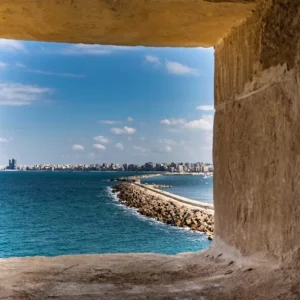
Standing proudly at the entrance of Alexandria’s Eastern Harbor, the Citadel of Qaitbay is a 15th-century defensive fortress built by the Mamluk Sultan Al-Ashraf Qaitbay in 1477 CE. Constructed to protect Egypt’s Mediterranean coast from Ottoman naval threats, the citadel remains one of the most important military strongholds along the North African coast.
-
Built on Ancient Wonder Ruins: The fortress was erected on the exact site of the fallen Lighthouse of Alexandria (Pharos). Mamluk builders repurposed shattered red granite pillars and limestone blocks from the ancient lighthouse directly into the citadel’s defensive walls and inner chambers.
-
Architectural Layout: The complex features thick outer stone walls, defensive watchtowers, an inner keep with vaulted stone ceilings, and a historic mosque—the oldest surviving mosque in Alexandria.
Bibliotheca Alexandrina: Rebirth of a Legendary Center of Knowledge
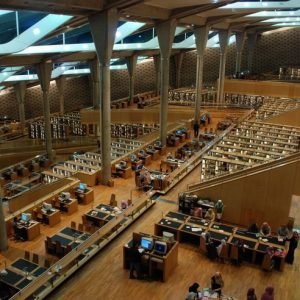
Inaugurated in 2002 near the site of the ancient Great Library, the modern Bibliotheca Alexandrina is a striking architectural masterpiece designed as a sun disc tilting toward the sea. Representing the rebirth of the ancient world’s greatest center of learning, the library serves as a global hub for literature, science, and the arts.
-
The Main Reading Hall: The library’s cascading 11-story main reading hall can accommodate up to 2,000 readers beneath a glass-panelled roof specially angled to filter natural sunlight into the study areas.
-
The Granite Wall: The exterior circular wall of the library is carved from massive grey Aswan granite, adorned with characters and letters from over 120 different human scripts, symbolizing universal knowledge and human dialogue.
Museums and Attractions Within the Library Complex
Bibliotheca Alexandrina is far more than a book repository; it is a sprawling cultural complex housing specialized museums and galleries:
-
The Antiquities Museum: Features a rare collection of artifacts discovered underwater in Alexandria’s sunken ancient harbors, alongside Pharaonic, Greco-Roman, and Byzantine antiquities.
-
The Manuscripts Museum: Preserves rare historical texts, ancient scrolls, and religious manuscripts dating back centuries.
-
The Sadat Museum: Dedicated to the life and legacy of Egyptian President Anwar El-Sadat, displaying personal belongings, medals, and historic documents.
-
The Planetarium Science Center: An interactive science center and 3D planetarium dome offering educational astronomy shows for adults and children alike.
Catacombs of Kom El Shoqafa and Pompey’s Pillar
A complete tour of Alexandria extends beyond the coast to explore the city’s unique Greco-Roman heritage hidden just inland:
-
Catacombs of Kom El Shoqafa: One of the Seven Wonders of the Middle Ages, this multi-tiered subterranean necropolis merges Egyptian, Greek, and Roman artistic styles across deep underground burial chambers, statues, and reliefs.
-
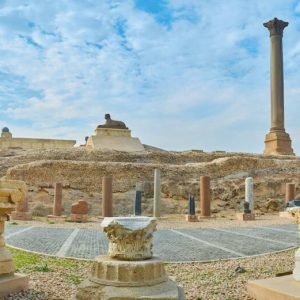
Pompey’s Pillar: A massive 27-meter red Aswan granite column erected in honor of Emperor Diocletian, standing alongside two sphinx statues within the ancient sanctuary grounds of the Serapeum.
Practical Visitor Guide: Exploring Alexandria
To make the most of a day trip or weekend getaway to Alexandria, keep these travel tips in mind:
-
Getting There: Alexandria is located approximately 2 hours north of Cairo by high-speed train or via the Cairo-Alexandria Desert Road.
-
Best Time to Visit: Spring (April to June) and Autumn (September to November) offer pleasant sea breezes and comfortable sightseeing temperatures.
-
Dining Along the Coast: Experience traditional Alexandrian seafood at local restaurants along the harbor, enjoying fresh Mediterranean fish and views of the fishing boats near Qaitbay Citadel.
Conclusion: Where History Meets the Horizon
Alexandria’s Bibliotheca Alexandrina and Citadel of Qaitbay showcase the incredible adaptability and spirit of Egypt’s Mediterranean coast. Whether exploring the ancient stone halls where the Great Lighthouse once stood or sitting beneath the modern glass canopy of a reborn library, Alexandria offers a serene, culturally rich experience unlike anywhere else in Egypt.
Practical Visitor Guide: Exploring Alexandria
To make the most of a day trip or weekend getaway to Alexandria, keep these travel tips in mind:
-
Getting There: Alexandria is located approximately 2 hours north of Cairo by high-speed train or via the Cairo-Alexandria Desert Road.
-
Best Time to Visit: Spring (April to June) and Autumn (September to November) offer pleasant sea breezes and comfortable sightseeing temperatures.
-
Dining Along the Coast: Experience traditional Alexandrian seafood at local restaurants along the harbor, enjoying fresh Mediterranean fish and views of the fishing boats near Qaitbay Citadel.
Conclusion: Where History Meets the Horizon
Alexandria’s Bibliotheca Alexandrina and Citadel of Qaitbay showcase the incredible adaptability and spirit of Egypt’s Mediterranean coast. Whether exploring the ancient stone halls where the Great Lighthouse once stood or sitting beneath the modern glass canopy of a reborn library, Alexandria offers a serene, culturally rich experience unlike anywhere else in Egypt.
Comment (0)